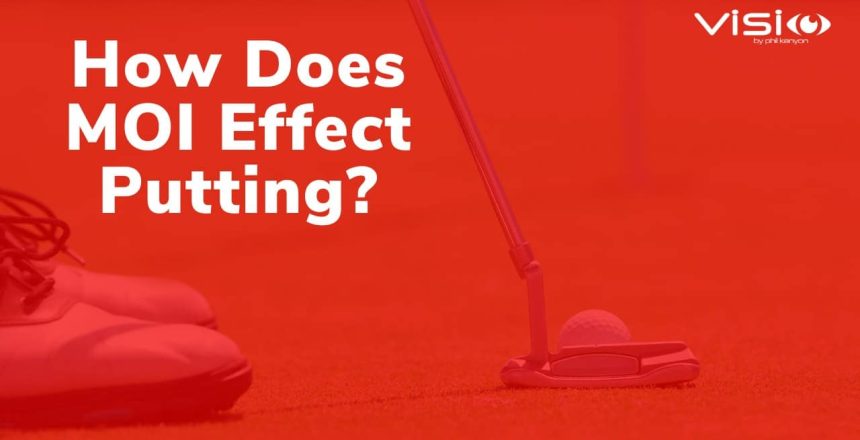
Questions we get asked a lot are ‘what does MOI mean?’ and ‘how could a putter with a higher MOI help me?’.
So let’s take a stab at this for you to see if you could benefit from digger deeper into MOI!
MOI stands for ‘Moment of Inertia’, and it is a concept used to describe the resistance of an object to rotational motion. When it comes to a putter in golf, MOI refers to the putter’s ability to resist twisting or rotating around a point when struck off-centre, the point being the centre of the face or sweet spot. Or it refers to the ease with which the golfer can twist the club themselves.
A putter with a higher MOI is designed to be more forgiving on off-centre strikes. It also means it’s more difficult for you to twist the club during motion. Resulting in more stable strokes and impacts.
The MOI of a putter is influenced by its design features, such as the distribution of weight throughout the head. Putters with larger and more perimeter-weighted designs tend to have higher MOI values because the weight is positioned away from the centre of the face, increasing stability and resistance to twisting.
It’s worth noting that while higher MOI putters offer advantages in terms of forgiveness and stability, they may also have a different feel and responsiveness compared to putters with lower MOI.
Golfers with varying stroke styles and preferences should experiment with different MOI options to find a putter that suits their individual needs and preferences. Some players need to be able to twist the club in order to make their strokes work.
Club manufacturers incorporate MOI considerations into their putter designs, providing a range of options to suit different player profiles. When selecting a putter, it is beneficial to try various models, considering factors such as head shape, weight distribution, and MOI, to find the optimal combination that enhances your putting performance.
#practicewithpurpose
Team Visio